
A transparent tablecloth placed on a garden table protects the surface from stains and scratches. The question that deserves to be asked concerns its durability against ultraviolet rays: does flexible PVC remain clear after several months of horizontal exposure in full sunlight, or does it yellow to the point of losing its aesthetic appeal? The answer largely depends on the type of UV treatment integrated into the material.
UV Stabilization in the Mass or Surface Treatment: What Changes for an Outdoor PVC Tablecloth
The transparent tablecloths sold for outdoor use do not all benefit from the same type of sun protection. The distinction between two manufacturing approaches directly affects the product’s durability.
A surface UV treatment (varnish or coating applied to the PVC film) is the most common solution for entry-level models. This protective layer wears off over time due to cleaning, folding, and the friction of objects placed on the table. After a few seasons, the UV barrier diminishes, and yellowing accelerates.
In contrast, a UV stabilization in the mass of the polymer incorporates protective agents directly during the manufacturing of flexible PVC. The stabilizer is distributed throughout the thickness of the film, making it resistant to surface abrasion. Transparency and flexibility are maintained significantly longer, even on a table exposed daily to sunlight.
This nuance is generally not mentioned on consumer product sheets. To choose a transparent UV-resistant tablecloth for outdoor use that truly lives up to its promises, one must check if the manufacturer explicitly mentions stabilization in the mass or if they merely provide a vague “UV-resistant” label.
| Criterion | Surface UV Treatment | Mass UV Stabilization |
|---|---|---|
| Effective Protection Duration | Decreases after a few seasons | Maintains for a significantly longer duration |
| Abrasion Sensitivity | High (cleaning, folding) | Low |
| Long-term Transparency | Accelerated gradual yellowing | Delayed yellowing |
| Price Range | Entry-level | Mid to high-end |
| Label Mention | Often absent or vague | Specified by specialized manufacturers |
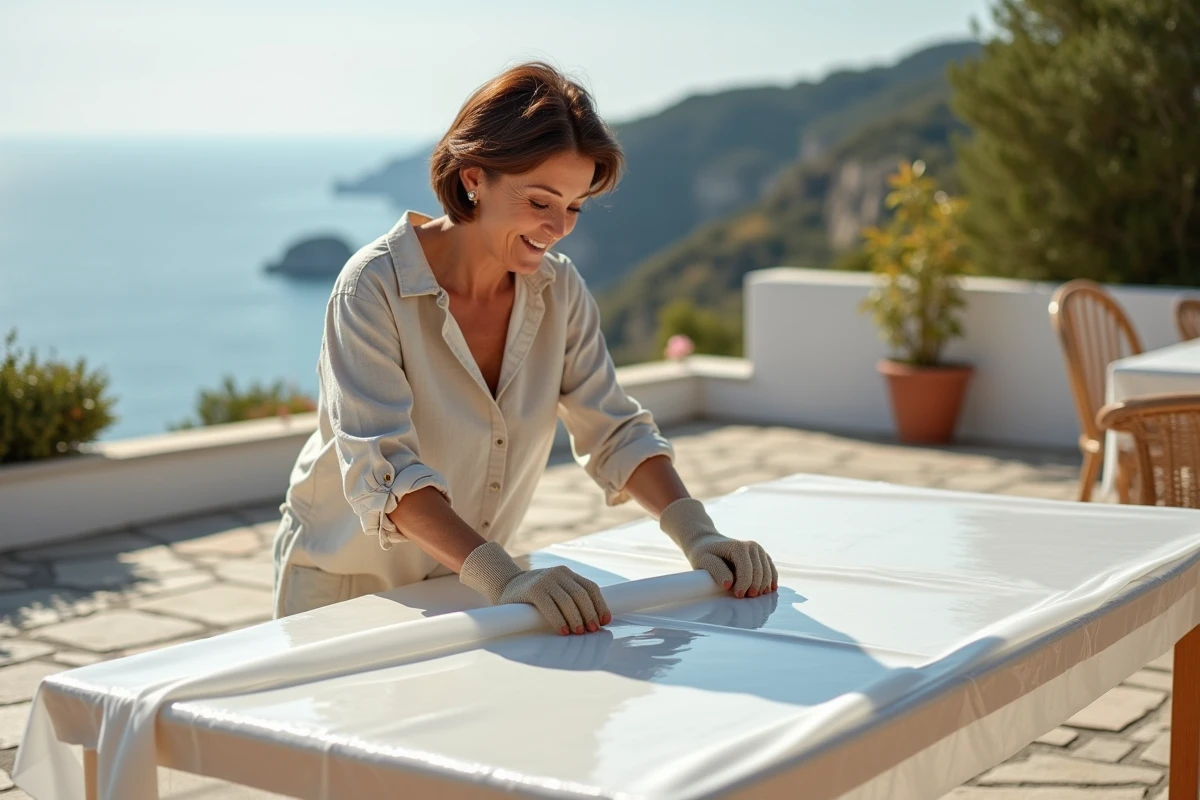
Horizontal Exposure and Yellowing: Why the Tablecloth Yellows Faster than a Glazing Film
A technical detail often overlooked explains why an outdoor transparent tablecloth degrades more quickly than a PVC film placed on a window. The horizontal orientation exposes the material to direct UV radiation and an accumulation of heat far greater than that received by a vertical surface.
On glazing, the film receives sunlight at a variable angle throughout the day, and natural ventilation limits heating. On a garden table, the tablecloth receives radiation almost perpendicularly during the hottest hours, and heat concentrates between the surface and the plastic film.
This phenomenon leads some specialized manufacturers to offer distinct formulations for horizontal outdoor use, with UV stabilizers reinforced compared to standard decorative films. Checking this mention on the technical sheet helps avoid a product designed for indoor use but sold indistinctly for the terrace.
Signs of Degradation to Watch for on a Crystal Tablecloth
- A yellowish veil first appears on the areas most exposed to direct sunlight, often the center of the table.
- Flexibility decreases: PVC becomes rigid at folds and may crack in cold weather if the stabilizers are depleted.
- Opaque micro-scratches multiply on the surface, indicating that the protective surface coating has worn off.
- A stronger plastic smell is released on hot days, indicating a chemical degradation of the material.
Maintenance of an Outdoor Transparent Tablecloth: Actions that Extend UV Protection
The maintenance method has a direct impact on the longevity of the UV barrier, especially for tablecloths with a surface treatment. A few simple precautions can prevent accelerating degradation.
Cleaning with a soft cloth and lukewarm soapy water remains the safest method. Abrasive products, scouring sponges, and cleaners containing alcohol or solvents attack the protective coating. On a mass-stabilized tablecloth, the risk is lower, but repeated abrasion can still dull the surface over time.
After cleaning, drying the tablecloth flat rather than folding it immediately prevents the formation of permanent creases. Flexible PVC retains the deformations it undergoes when hot: folding the still-warm tablecloth after a day in the sun creates marks that are difficult to remove.
Off-Season Storage and Soft PVC Creases
Rolling the tablecloth around a cardboard tube rather than folding it limits folding marks. The roll should be stored horizontally, in a cool place and out of direct light.
If creases have already formed, laying the tablecloth flat in the sun for a short time is usually enough to reduce them. The heat softens the PVC, allowing it to regain its natural shape. Using a hairdryer or an iron directly on the film risks causing localized deformation or burning.
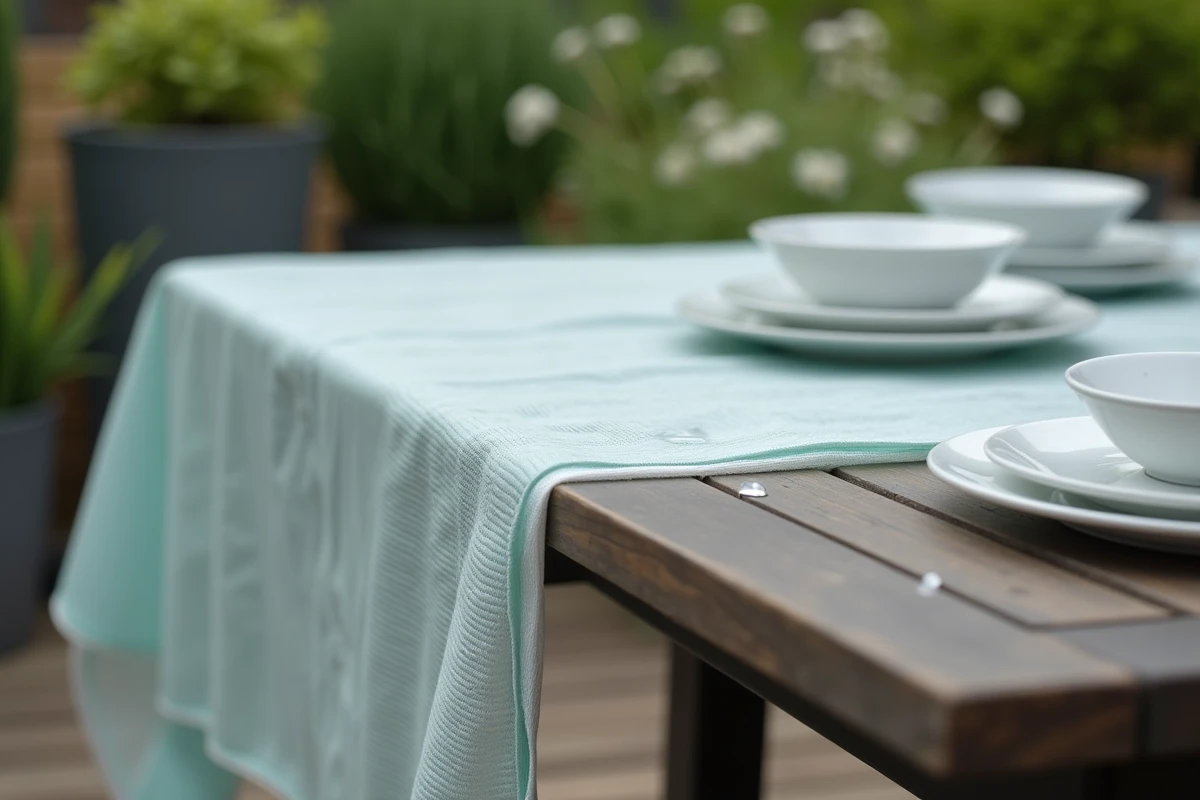
Thickness and Quality of PVC: Selection Criteria for a Durable Protective Tablecloth
The thickness of the PVC film influences both mechanical resistance and UV durability. A thicker film contains more stabilized material, which slows yellowing. The thinnest tablecloths, often intended for occasional use, degrade significantly faster in permanent outdoor settings.
Choosing a sufficiently thick crystal PVC also improves user comfort: the tablecloth stays better in place on the table, withstands wind better, and absorbs more shocks from objects placed on the surface.
- Check that the product mentions horizontal outdoor use and not just indoor or glazing use.
- Look for the mention “mass stabilization” or “long-lasting UV” rather than just a simple sun pictogram.
- Prefer a manufacturer that clearly distinguishes its indoor and outdoor ranges, indicating an adapted formulation.
The choice of a transparent UV-resistant tablecloth for outdoor use ultimately hinges on a criterion rarely highlighted: the location of the stabilizer in the material. A mass-stabilized tablecloth, cleaned without abrasives and stored rolled, retains its transparency and flexibility far beyond a model treated only on the surface.