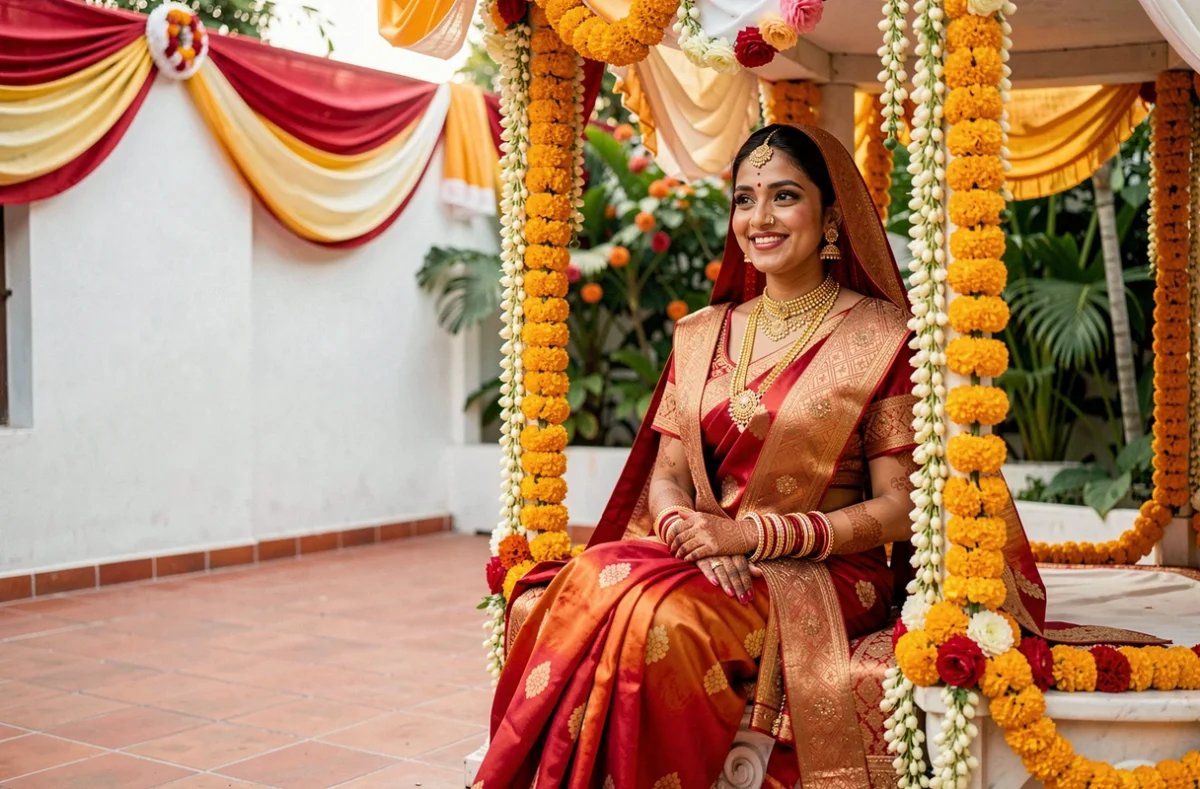
Betashar kazakh, a ceremony presenting the bride to the groom’s clan, was inscribed on UNESCO’s Intangible Cultural Heritage list in 2024. That same year, henna-related rituals joined the list through a joint nomination by 16 Arab states. These two inscriptions are a reminder that wedding traditions are living practices governed by communities—not a catalogue of decorative ideas to pick and choose from freely.
Cultural appropriation and weddings: where to draw the line
Adopting a wedding ritual from another culture without understanding its significance strips it of meaning. Betashar, for example, includes a formal song of address and the unveiling of the bride’s face, with each step carrying a specific meaning for the host family. Reproducing the unveiling in a different context, without the song or the family, turns a social act into a stage prop.
When UNESCO inscribed henna-related practices, it also highlighted the risk of decontextualization and excessive commercialization. Depending on the region, wedding henna is accompanied by songs, poems, or proverbs passed down orally. Isolating the henna application and turning it into a “workshop” at a Western cocktail party, without consulting or paying the artisans who uphold these traditions, raises a documented ethical concern.
For a closer look at wedding traditions around the world in all their diversity, one useful resource is https://www.mariagesdumonde.net, which details customs by country and region.
Before incorporating a borrowed ritual, ask yourself three questions:
- Does the community of origin consider this ritual open to others, or is it reserved for its members? An officiant or consultant from that culture can answer directly.
- Are the people who pass on this knowledge involved in the planning and paid for their work? Not just a “thank you” on Instagram—real compensation.
- Does the ritual retain its structure and meaning, or has it been reduced to a visual element stripped of its narrative context?
Wedding traditions in France, Ireland, and Scotland: what sets them apart
European weddings are often seen as a homogeneous whole. The details tell a different story.
France: the ribbon and the chamber pot
The tradition of stretching a ribbon across the wedding procession for the couple to cut together persists in several rural regions. It symbolizes the obstacles the couple will overcome. The chamber pot filled with chocolate and champagne, served to the newlyweds at the end of the evening (la soupe), is still common in the southwest and Brittany, although its contents have changed.
Ireland: handfasting
Irish handfasting physically binds the couple’s hands with a ribbon or cord. This pre-Christian practice has been incorporated into civil and secular ceremonies. The choice of fabric, its color, and the type of knot vary from family to family. Some Irish officiants offer adapted versions for non-Irish couples, providing an example of transmission that is both consensual and guided.
Scotland: tartan and the quaich
Wearing a kilt and family tartan at a Scottish wedding is not merely decorative: each tartan identifies a clan. The quaich, a two-handled cup from which the couple drink together, symbolizes trust. Wearing a tartan with no clan connection is considered a faux pas by most Scottish families, although some “universal” tartans are available to visitors.
Khmer weddings and Papua New Guinea: the diversity of traditions
A common pitfall in articles about weddings around the world is describing “the” wedding of a country as though there were only one version. Khmer weddings illustrate this well.
Traditional Khmer ceremonies once included several days of successive rituals. Today, they often take place over a single day. The rituals and their order vary by region in Cambodia and from family to family. Describing “the” Khmer wedding as a fixed sequence ignores this flexibility, which is precisely what keeps the tradition alive.
In Papua New Guinea, diversity is even more pronounced. The country is home to several hundred language groups, each with its own marriage practices. Dowry systems, bridewealth, and negotiations between families differ radically from one valley to another. Speaking of a “Papuan wedding” in the singular makes no ethnographic sense.
Legal status and cultural ceremony: two distinct realities
A culturally rich wedding ceremony does not guarantee legal recognition. Kristopher Velasco’s LGBTI National Policy Dataset, covering 1991–2025 and presented by Our World in Data, distinguishes between countries that recognize same-sex marriage, those that allow only civil unions, and those that prohibit it.
This distinction also matters for heterosexual couples who want to celebrate a traditional rite abroad. A customary marriage, however beautiful and formalized, may have no legal standing in the couple’s country of residence. Checking its legal validity before organizing the ceremony helps avoid administrative complications upon returning home.
We also see that the trend of combining several traditions in a single ceremony raises questions about symbolic coherence. Bringing together Irish handfasting, an American sand ceremony, and Moroccan henna over the same weekend creates a patchwork that leaves none of the source traditions intact.
The most reliable criterion is the active participation of people from the tradition in question—not as extras, but as guides to the ceremony. A wedding that draws on a culture while paying its practitioners and respecting the structure of the rite is clearly different from one that simply imports its aesthetic.