
A whipped cream can that refuses to dispense anything while still sounding “full” when shaken: the problem is more mechanical than culinary. The cream is there, the gas sometimes too, but something prevents the mixture from flowing to the valve. Understanding what happens inside the container allows for fixing the issue in a few seconds in most cases.
Grease clog in the internal tube: the most common blockage
The mechanism of an aerosol can relies on a dip tube that reaches the bottom of the container. The cream, pushed by the propellant gas (nitrous oxide, N₂O), rises through this narrow tube when the valve is pressed. The problem occurs when the fat in the cream solidifies inside this tube.
Technical sheets from manufacturers of food propellants confirm that rapid temperature changes between transport and refrigerator promote the formation of solidified grease clogs in the internal tube. Specifically, a can bought at the supermarket, placed in a hot car and then returned to the cold, experiences a thermal shock sufficient for the lipids to crystallize at the entrance of the tube.
This phenomenon explains why a can works perfectly on the day of purchase and then gets blocked after a few hours in the refrigerator. The cream is not expired, the gas has not leaked: it is a physical obstacle in the circuit.
When a blocked whipped cream can after opening shows this type of symptom, the most direct solution is to take the can out of the refrigerator and let it sit at room temperature for about ten minutes, then shake it vigorously upside down before trying again.
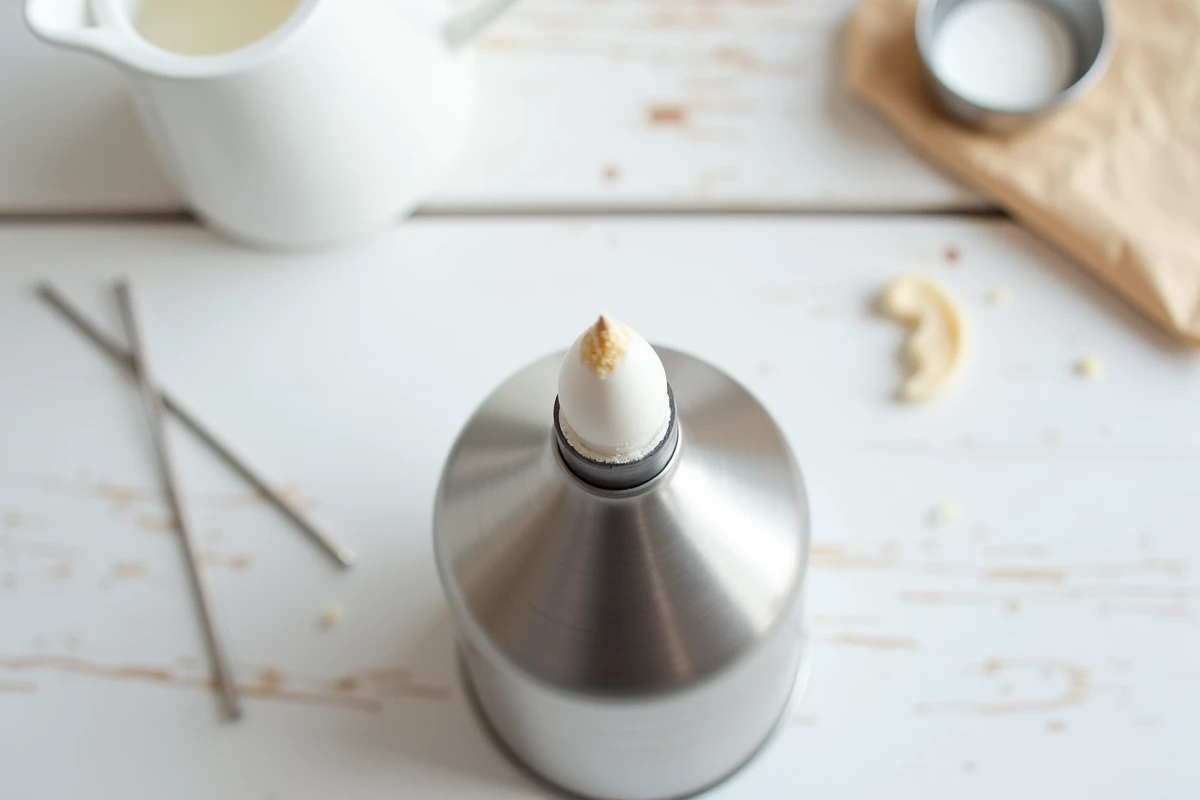
Storage position in the refrigerator: nozzle up or nozzle down
For several years, several major brands of aerosol whipped cream in Europe have added the note “Store nozzle down after opening” on their labels. This is not a marketing detail.
When the can is stored nozzle up, the lighter propellant gas migrates to the top of the container and gradually dissociates from the cream. When pressing the valve, pure gas is released, without cream, which gives the impression that the can is empty or blocked. The cream remains stuck at the bottom, intact but inaccessible.
Storing the can nozzle down keeps the gas in contact with the mixture and allows the propellant to continue pushing the cream towards the outlet. Practical tests published by European consumer associations between 2023 and 2024 indicate that this simple storage habit significantly reduces cases of blockage.
What to do if the can has been stored in the wrong position for too long
Turning the can nozzle down in the refrigerator for an hour is usually enough to restore the gas-cream contact. Shaking the container about fifteen times before use helps to redistribute the propellant in the mixture.
Defective valve or faulty crimping: when the problem is not your fault
Not all blocked cans result from improper handling. Several recent recalls of whipped cream cans in the United States, the United Kingdom, and Australia have revealed that entire batches can have poorly designed valves or crimping. The consequences vary: complete blockage after a few uses, or a slow gas leak that depletes the pressure while there is still cream in the container.
Identifying a manufacturing defect is not obvious. A few clues point to this possibility:
- The can has never worked, even on the first use, despite correct temperature and storage.
- A continuous hissing is heard at the valve without pressing it, indicating a gas leak at the seal.
- The cartridge or propellant seems intact (the can is heavy, you can hear the liquid), but nothing comes out and the valve does not resist finger pressure at all.
In these cases, the can should be returned to the point of sale. Recalls issued by food safety agencies between 2023 and 2025 confirm that this type of defect is not trivial in certain batches.

Kitchen siphon: a different blockage with specific causes
Reusable whipped cream siphons (with individual gas cartridges) also experience failures, but of a different nature. The mechanism is more complex than a simple aerosol can: the N₂O cartridge is pierced in a cartridge holder, the gas diffuses into the tank, and the cream exits through a nozzle equipped with a seal and a spring.
A worn or misaligned seal is the primary cause of failure in a siphon. If the silicone O-ring of the lid is cracked, flattened, or missing, the gas escapes during tightening, and the mixture cannot build pressure. Replacing this seal is inexpensive and resolves the majority of blockages in common models.
Another common cause in siphons: clogging of the nozzle by residues from previous preparations. Sweet creams, mousses, and egg-based culinary preparations leave a protein film that hardens upon drying. Thorough cleaning after each use, with a hot water rinse through the nozzle and brushing the valve with a fine bottle brush, prevents this problem.
Pierced gas cartridge but siphon still silent
When the cartridge has been properly pierced (you can hear the gas entering) but nothing comes out, check these points in order:
- The amount of cream exceeds the maximum level indicated on the tank, leaving insufficient space for the gas to pressurize the mixture.
- The cream used does not have a sufficient fat content to whip under pressure (light creams do not whip in a siphon).
- The nozzle or internal seal is blocked by dry residue, preventing output despite correct pressure in the tank.
The kitchen siphon remains a reliable tool when these few maintenance points are respected. A complete disassembly and hot water cleaning after each use are enough to avoid the vast majority of blockages in the long term.
Whether it’s an aerosol can or a siphon, the blockage almost always has a simple mechanical explanation. Temperature, storage position, and the condition of seals cover almost all cases. Keeping the can nozzle down in the refrigerator and checking the seals of the siphon before each use are the two habits that save the most frustration in the kitchen.