
Sales of domestic freezers have significantly rebounded in France since 2022-2023, driven by food inflation and the return of bulk purchases. Behind this renewed interest lies a fundamental question: does a freezer provide real value in daily life, or is it an appliance destined to clutter the garage? Answers vary depending on household size, shopping habits, and energy costs.
Domestic Freezer and Food Stock Management: What Has Changed
The freezer integrated into the refrigerator is sufficient for most everyday uses. The standalone freezer, whether chest or upright, meets a different need: storing a larger volume over an extended period.
The rise in food prices has altered purchasing behaviors. Promotions on meat, fish, or vegetables packaged in family-sized lots encourage many households to build up reserves. Direct purchases from local producers (quarter of beef, farm-raised poultry packages) also require dedicated storage space that a standard refrigerator’s freezing compartment cannot provide.
To better understand the advantages of a domestic freezer, one must first distinguish between two logics: opportunistic buying (taking advantage of a temporary low price) and meal planning over several weeks. In both cases, the freezer acts as a buffer between the time of purchase and consumption.
Energy Consumption of Freezers: The Impact of New European Labeling
One of the most frequently cited barriers remains the electricity bill. The European energy relabeling of 2021, with a return to the A-G scale, has clarified the situation. The updates for 2023-2024 have tightened requirements even further, and retailers are beginning to remove the most energy-consuming classes from their shelves.
A recent freezer classified in the best categories consumes significantly less than an older model. The difference over the appliance’s lifespan (often exceeding ten years) translates into a significant gap in total cost of ownership.
Several technical criteria guide the choice:
- The type of appliance: a chest freezer generally offers better thermal insulation than an upright model, as the cold air (denser) stays at the bottom when the lid is opened instead of escaping through the door.
- The actual energy class on the new A-G scale, not the old rating (an old A++ may be rated D or E after relabeling).
- The presence or absence of a No Frost system: it prevents frost formation and maintains cooling performance but may slightly increase consumption compared to a well-maintained static model.
- The usable volume relative to the household’s actual needs, as an oversized and half-empty appliance consumes more per kilogram stored.
The available data do not allow for a universal breakeven threshold: the annual cost depends on local electricity rates, the volume stored, and the frequency of opening.
Food Waste and Freezer: A Benefit Under Conditions
The anti-waste argument consistently appears in discussions favoring the domestic freezer. Freezing leftovers, ripe fruits, or excess garden vegetables indeed prevents them from ending up in the trash. However, this benefit relies on a discipline of use that not all households maintain over time.
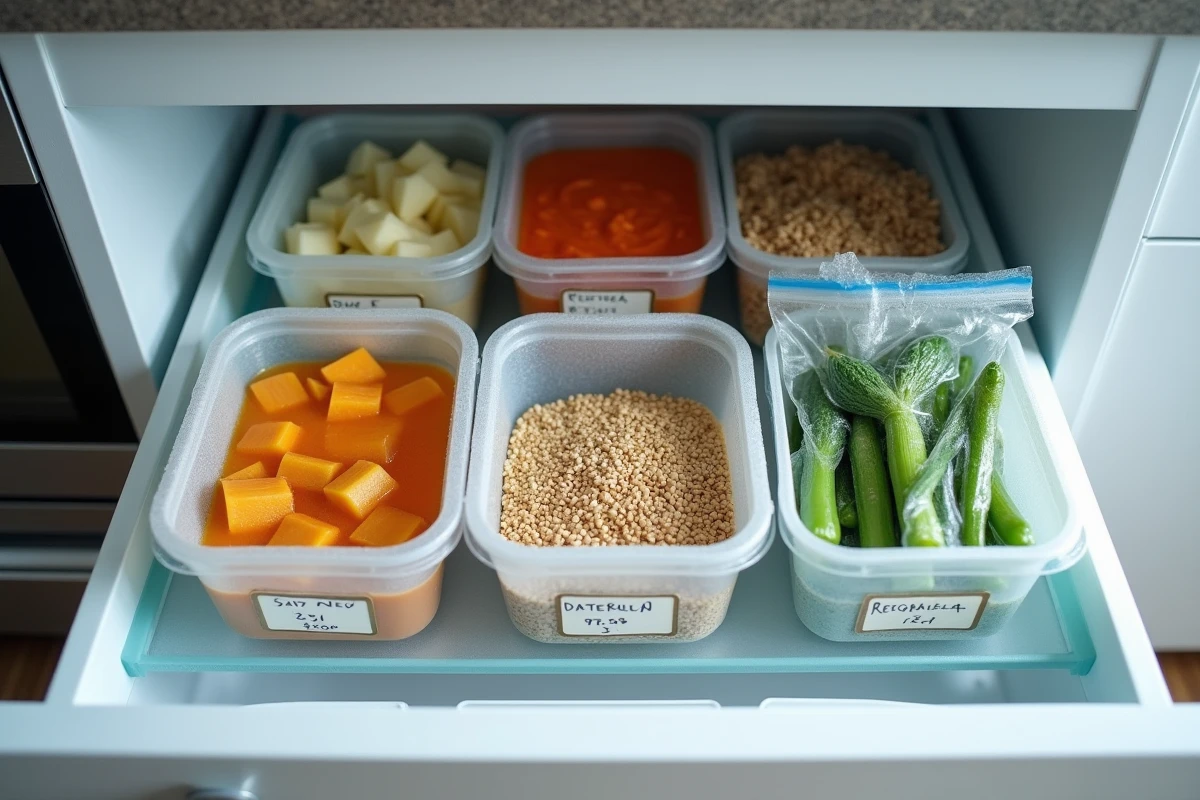
A poorly organized freezer becomes a food graveyard. Products buried at the bottom of a chest lose nutritional and taste quality over the months. Without regular stock rotation, the anti-waste gain is nullified, or even reversed, when items end up being thrown away after months of neglect.
Rapid freezing (very quick lowering of the core temperature) better preserves the cellular structure of foods than the slow freezing of a standard domestic appliance. The ice crystals formed are finer and cause less damage to the fibers. Field reports vary on this point: some manufacturers claim rapid freezing functions on their recent models, but the result depends on the quantity of food introduced simultaneously and the initial temperature of the product.
Connected Freezer and Recent Functions: Gadget or Real Help

Since 2023, several major manufacturers have offered freezers with temperature management via mobile app, open door alerts, and notifications in case of power outages. Some models even integrate inventory tracking by scanning.
The alert in case of a malfunction or power outage is the most useful function for a household that stores valuable products (bulk-purchased meat, homemade meals). An undetected prolonged outage can lead to the loss of all contents, a particularly costly risk when the freezer is full.
Inventory functions, on the other hand, remain anecdotal for most users. Scanning each product before storing it requires an effort that few people maintain daily. The technology exists, but actual usage remains to be demonstrated on a large scale.
Volume, Location, and Noise: Overlooked Constraints
The choice of a freezer is not limited to cooling performance and energy class. The location in the home conditions long-term comfort of use. A large-capacity chest freezer can exceed 150 cm in width: it requires a garage, pantry, or laundry room to accommodate it.
The room temperature also influences the appliance’s operation. An unheated room in winter or overheated in summer forces the compressor to work harder, increasing consumption and wear. Upright models integrate more easily into kitchens, but their usable volume is often lower than the external capacity suggests.
Noise level deserves attention if the appliance is installed in a living space. Recent freezers are generally quieter, but variations between models remain noticeable.
Adopting a domestic freezer represents an investment that is justified when the household regularly buys in bulk, cooks in advance, or wants to limit trips to the store. The real benefit depends as much on stock management habits as on the appliance itself. A high-performing freezer that is poorly used remains a cost center, not a source of savings.