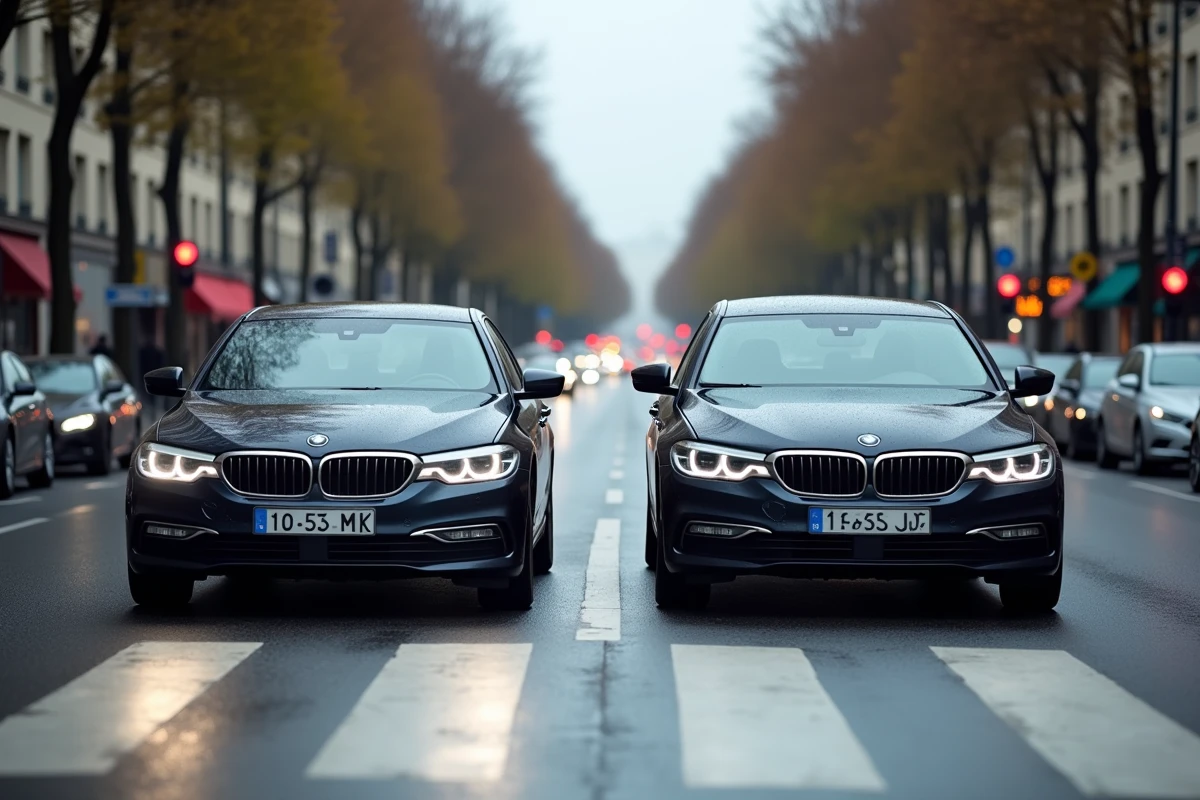
The Highway Code requires maintaining a safe distance from the vehicle in front, regardless of the traffic area. In the city, this distance between two cars follows the same principles as on roads or highways, but real conditions make it more difficult to assess and adhere to.
Vulnerable road users and safe distance in the city: an underestimated parameter
Most driving guides calculate the safe distance solely based on speed. In urban areas, this reasoning is incomplete. The density of pedestrians, cyclists, and scooters on the roadway or near crosswalks radically changes the risk of collision, even at low speeds.
CEREMA, in its technical guide on road sharing in urban environments (2023 edition), recommends maintaining a larger margin than in rural areas at the same speed. The reason lies in the masking effect: a vehicle that is followed too closely hides a pedestrian who is stepping off the sidewalk or between two parked cars.
Considering the distance between 2 cars in the city requires taking into account these interactions between users, and not just the theoretical braking time.
In a 30 km/h zone, where the coexistence of different modes of transport is maximized, this additional margin becomes particularly relevant. Driving at 28 km/h, closely tailing the vehicle in front, provides no visibility on what is happening at ground level, where the most exposed users are moving.
Article R412-12 of the Highway Code: what the text says and what it does not
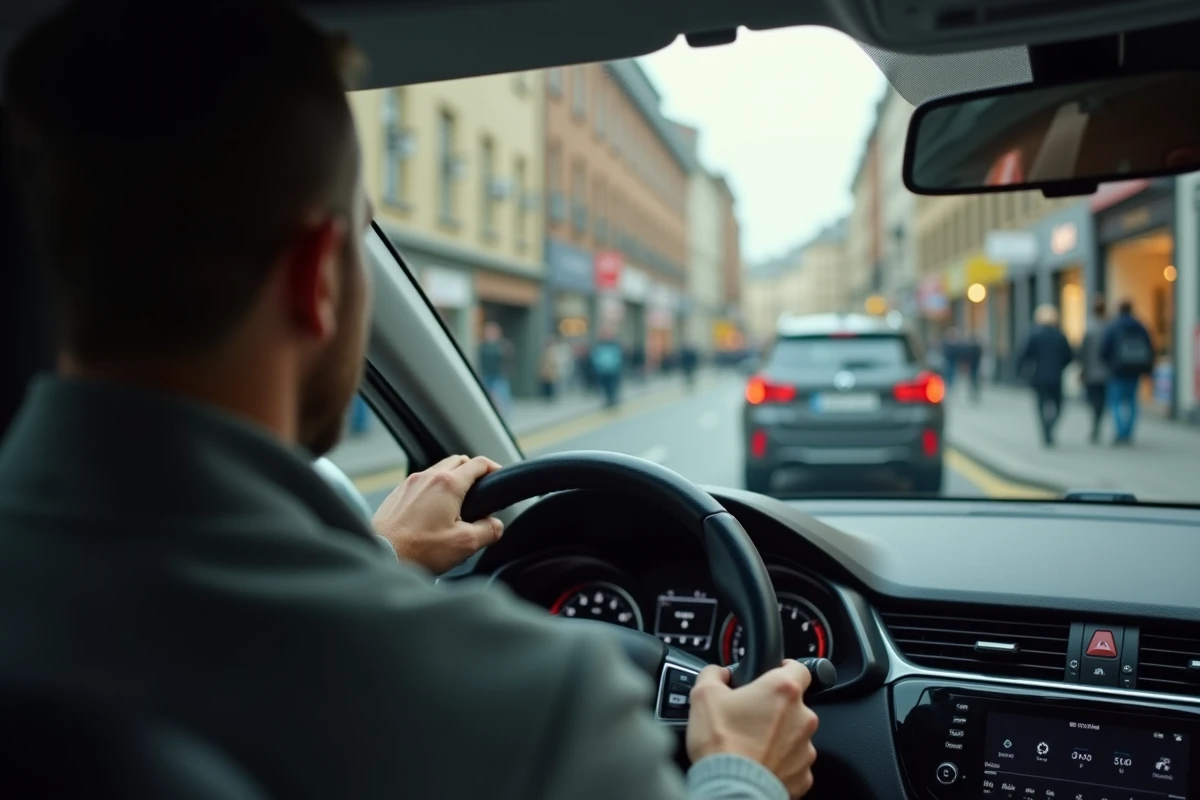
Article R412-12 of the Highway Code constitutes the regulatory basis. It requires the driver to leave between their vehicle and the one in front a gap corresponding to the distance traveled in at least two seconds. This principle applies in the city as well as outside urban areas.
At 50 km/h (a common limit in urban areas), two seconds represent about 28 meters. At 30 km/h, it drops to about fifteen meters. These values often surprise: in urban traffic, few drivers actually leave such space.
The text does not set a distance in meters. It reasons in time, making it adaptable to any speed. However, it does not mention any adjustments related to specific urban conditions, such as the presence of a bus stop, a school exit, or an adjacent bike lane. The assessment remains that of the driver.
Sanctions for non-compliance
Failing to respect the safe distance constitutes a fourth-class offense. It results in a deduction of three points from the driving license and a fixed fine. In the event of a collision, the infraction may aggravate the driver’s liability with their insurer and alter the coverage of damages.
ADAS systems in the city: a false sense of security regarding distances
Driving aids (adaptive cruise control, automatic emergency braking, distance alert) are becoming widespread in the vehicle fleet. Their promise is simple: to compensate for human errors in judgment. Field feedback nuances this discourse, especially in dense urban traffic.
Several observations show that drivers equipped with these systems are willing to drive closer to the vehicle in front, particularly during stop-and-go traffic phases. Trust in electronics reduces personal vigilance and, paradoxically, narrows actual safety margins.
This phenomenon raises an open question: do ADAS truly compensate for the increased risk they generate by altering driver behavior? The available data do not allow for a definitive conclusion, but the observation of closer inter-vehicle distances in the city among assisted drivers regularly appears in road behavior analyses.
- Adaptive cruise control works less effectively at very low speeds, precisely the most common urban range.
- Emergency braking poorly detects two-wheelers and pedestrians appearing laterally, a frequent scenario in the city.
- The audible distance alert, often disabled out of annoyance in dense traffic, loses all utility.
Assessing the safe distance in the city without ground reference
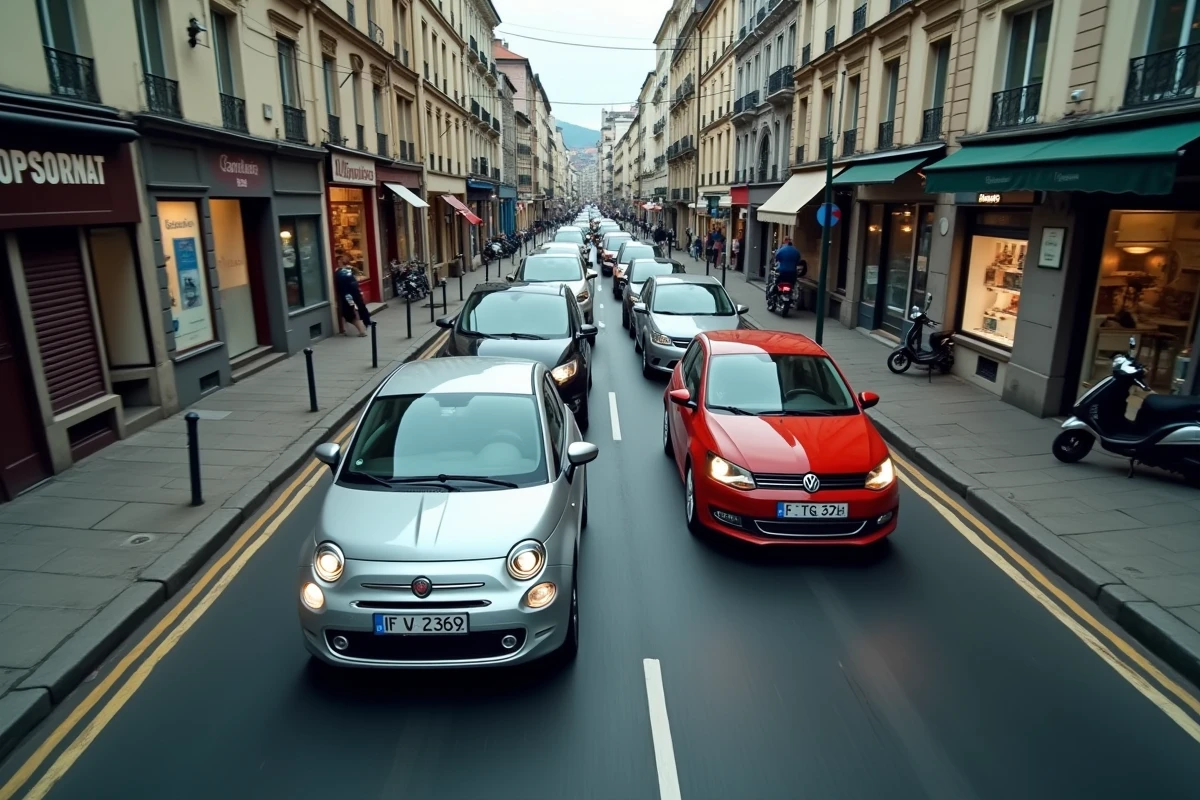
On the highway, regularly spaced white lines provide a reliable visual reference. In the city, this marking does not exist. The driver must resort to other methods to estimate their safe distance.
The fixed point technique
The simplest method is to choose a fixed reference point (pole, sign, crosswalk) and count the seconds between the moment the vehicle in front passes it and when you reach it. If you count less than two seconds, you are too close.
This technique works well at stabilized speeds. It becomes trickier in stop-and-go traffic, with frequent accelerations and braking. In this case, monitoring the visible ground space between the two vehicles remains the most reliable reflex: if you can no longer see the base of the rear tires of the vehicle in front, the margin is insufficient.
Conditions that require increasing the distance
- Wet or cobbled road, which significantly increases the braking distance compared to a dry surface.
- School exit, market approach, or shared pedestrian street, where a sudden stop of the vehicle in front is likely.
- Driving behind a bus or delivery vehicle, whose frequent and sudden stops require increased anticipation.
- Presence of an intercalated two-wheeler, whose braking distance differs and whose stability is lower.
The generalization of 30 km/h zones in city centers also alters drivers’ perceptions. At low speeds, the sense of safety increases, and the space left with the preceding vehicle decreases reflexively. However, the two-second interval remains the regulatory reference, regardless of the speed practiced.
Maintaining this distance in the city is as much about personal discipline as it is about understanding the urban context. The regulations set a framework, but it is the adaptation to real conditions (visibility, user density, road state) that determines the effective safety of each trip.