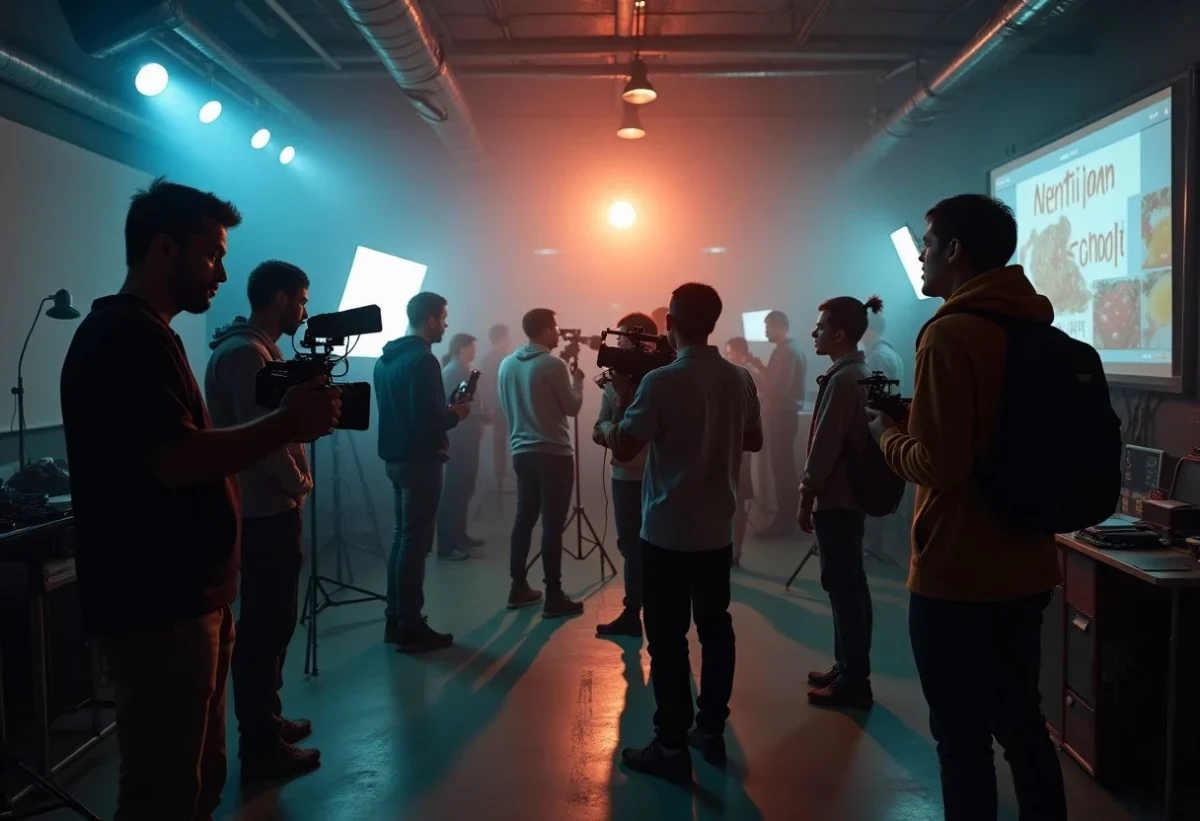
Every year, thousands of enthusiasts cling to a dream: to write, direct, and invent worlds and stories under the harsh light of the spotlight. Cinema is not tamed like a simple tool; it is lived, learned, and worked on, at the intersection of technique, imagination, and unwavering perseverance. Between classrooms, bustling sets, and sleepless nights of editing, the journey is as demanding as it is stimulating.
The Great Film Schools
Those who truly want to make directing their playground often choose to enroll in a film school. Far from a simple overview, these institutions allow students to explore every corner of the profession, mastering storytelling, technique, and the various demands of the seventh art.
Several institutions, sometimes cited as must-visit places in the industry, stand out:
- La Fémis: A true creative laboratory nestled in Paris, La Fémis trains numerous directors, cinematographers, and editors, who can be found on both French screens and abroad. Its teaching emphasizes immersion: each student goes through all stages of the filmmaking process through workshops and actual shoots.
- Louis Lumière: This school embodies French technical rigor. From lighting to sound recording, each section offers a scientific and precise approach, designed for those who want to understand and master every detail.
- ESRA: Here, there is no compartmentalization: theory and practice intersect every week. Students engage with all facets of production, from script development to the final touch, coming out of the editing suite.
The Path to Directing
Directing a film from start to finish cannot be improvised. Before being able to lead a team and bring a universe to life, every director must go through a series of structuring steps.
First, everything takes root in the script. Without a solid text, there are no convincing characters or dramatic tension: it is the backbone of the project. Next comes pre-production, intense and sometimes chaotic: choosing the right location, assembling the team, refining the breakdown… The decisions made at this stage shape the film’s personality. During shooting, the ability to manage the unexpected proves decisive. One must know how to gather, convince, and sometimes improvise without ever sacrificing the overall vision.
Finally, comes the editing stage. A moment of patience and meticulousness, where each shot is weighed, rearranged, until the film gains its texture, elasticity, and unique breath.
The Technical Skills to Acquire
Limiting oneself to creativity does not open all doors. It is also about equipping oneself with solid technical knowledge. Several areas require true mastery:
- The Camera: Knowing how to compose a frame, manage light, select the appropriate lens for the scene’s mood, work on fluidity and movement… These are skills that can only be acquired through experimentation and practice.
- Editing: The use of software such as Adobe Premiere Pro or Final Cut Pro is now part of the equation. Knowing how to structure a sequence, play with rhythm, and chain shots together all contribute to visual storytelling.
- Sound: Poorly managed recording can sabotage any film, even the most inspired. Therefore, one must learn to choose the right microphones, adapt to often imperfect conditions, and eliminate unwanted noise during both shooting and mixing.
First Steps and Opportunities in the Industry
After a Film Training, many immerse themselves in the industry as soon as a door opens. The beginnings may resemble long hours as an assistant on short films, associative shoots, or student projects. This is where habits are formed, and contacts accumulate. Nothing compares to the energy of the first sets, where one discovers how theory differs from practice.
As experiences accumulate, roles evolve: operator, editor, and sometimes team leader or designated director. Festivals then become crucial stepping stones. Presenting one’s own film, crossing paths with a producer, being noticed during a screening… Each project can open new horizons or remind one that reinvention is a constant necessity.
Cinema tests tenacity at every stage. Yet, through perseverance and boldness, it is not uncommon to see a silent passion assert itself until a new name finds its place in the credits. A promise that is not told: it is crafted, shot by shot.